About
35+ games shipped
5 patents in 3 domains
Drag to interact — tap a patent to view it
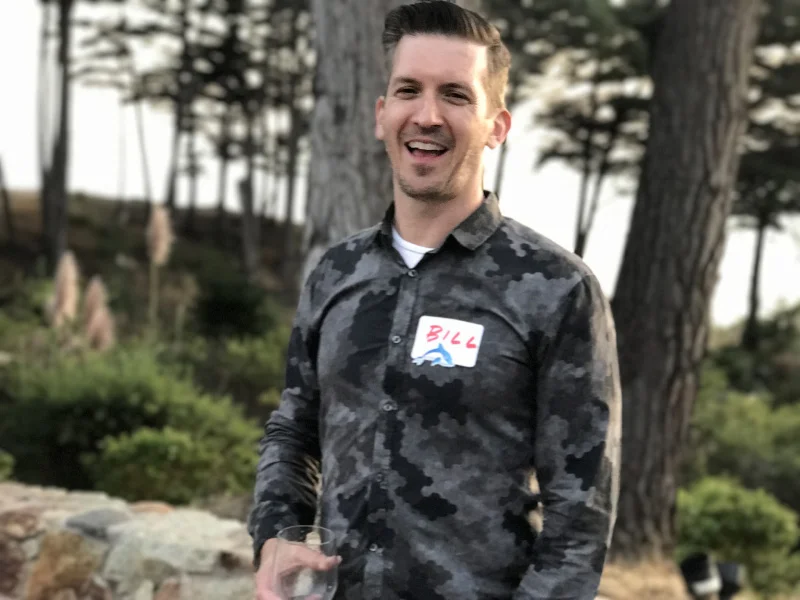
Hello, I’m Bill. Welcome to my About page,
My Maxims
Keep your design hatchet ready.
Chop the complexity in half. Playtest. Then swing anew. Game designers forget their amazing ideas were once new to them — players get overwhelmed fast. Keep reducing until you find the core loop, then build back carefully. Removing features is often more powerful than adding them.
Resist the urge to make it beautiful.
Polishing feels satisfying, but it's a trap. Keep pencils and prototypes loose — black and white signals an idea can still change, and it invites collaboration from everyone, not just visual thinkers. Non-designers freeze when they see realism; they assume it's finished, or that you'll be offended by their notes. My storyboards have rallied teams, won executive buy-in, and earned full-time job offers — precisely because they never looked done.
Only change one variable before you playtest anew.
Change two things at once and you'll never know which one moved the needle. Discipline here is what makes iteration actually mean something.
Speak publicly each year about something you love.
As expertise grows, the ability to share it clearly has to grow with it. Speaking keeps you humble and connected to people with the same questions you once had. I've spoken at The White House, TEDxGrandRapids, GDC, Games for Health, and Carnegie Mellon — find your topic, find your audience, show up. It doesn't take much prep. What's normal to you is valuable to someone else.
From an early age, I split my time between preparing for an engineering degree and winning scholarships to weekend art classes at Pittsburgh's Carnegie Museum and CMU. Industrial Design at Carnegie Mellon let me fuse my love of world-building from Dungeons & Dragons with the community service of my advancement to Eagle Scout. An exchange semester in Germany rebalanced my life and opened my eyes to differences in education, culture, and leisure. Building three-dimensional solutions to human problems became the foundation for a career in games, well-being, and learning design. I'm always evolving.
I've grown from individual contributor to a specialist dedicated to the hardest design challenges: user engagement, health improvement, staying curious. I listen more than I speak, separate ideas from the people who hold them, and build bridges of understanding with customers, teammates, and leadership. I'm a design ambassador.
In 2016, Autodesk Education hired me as a contractor to get users diving deeper into Fusion 360. The work succeeded well enough that they created a full-time role and hired me as the team's first remote employee. Working across San Francisco, Toronto, and New York, I helped build a data-driven prototype that debuted at Autodesk University, and later shipping as The Autodesk Learning Engine. Autodesk CEO Andrew Anagnost said it best: "It's an amazing experience to have play put into what you do every day!" I’m a visionary.
After years as an independent in the games industry, I reached out to MeYou Health the moment I saw their job posting. I found a profound sense of purpose fusing genuine game mechanics with behavior change theory. Our scientifically validated, data-driven products grew to a suite of 5 well-being apps sold to insurers and major corporations. I mentored every product designer on the team and spoke about game design thinking at GDC, Games for Health, and The White House. I give back.
At Level Ex, I spent 4 years designing games for doctors, including Discover TD, winner of a Trailblazer Award. I scaled Product Theater from an 8-person prototype into a live conference platform used by hundreds of healthcare professionals streaming on their phones. I called our approach "two halves of the same design brain": teaching game designers to think in patient profiles, and medical professionals to think in scoring systems. I’m highly collaborative.