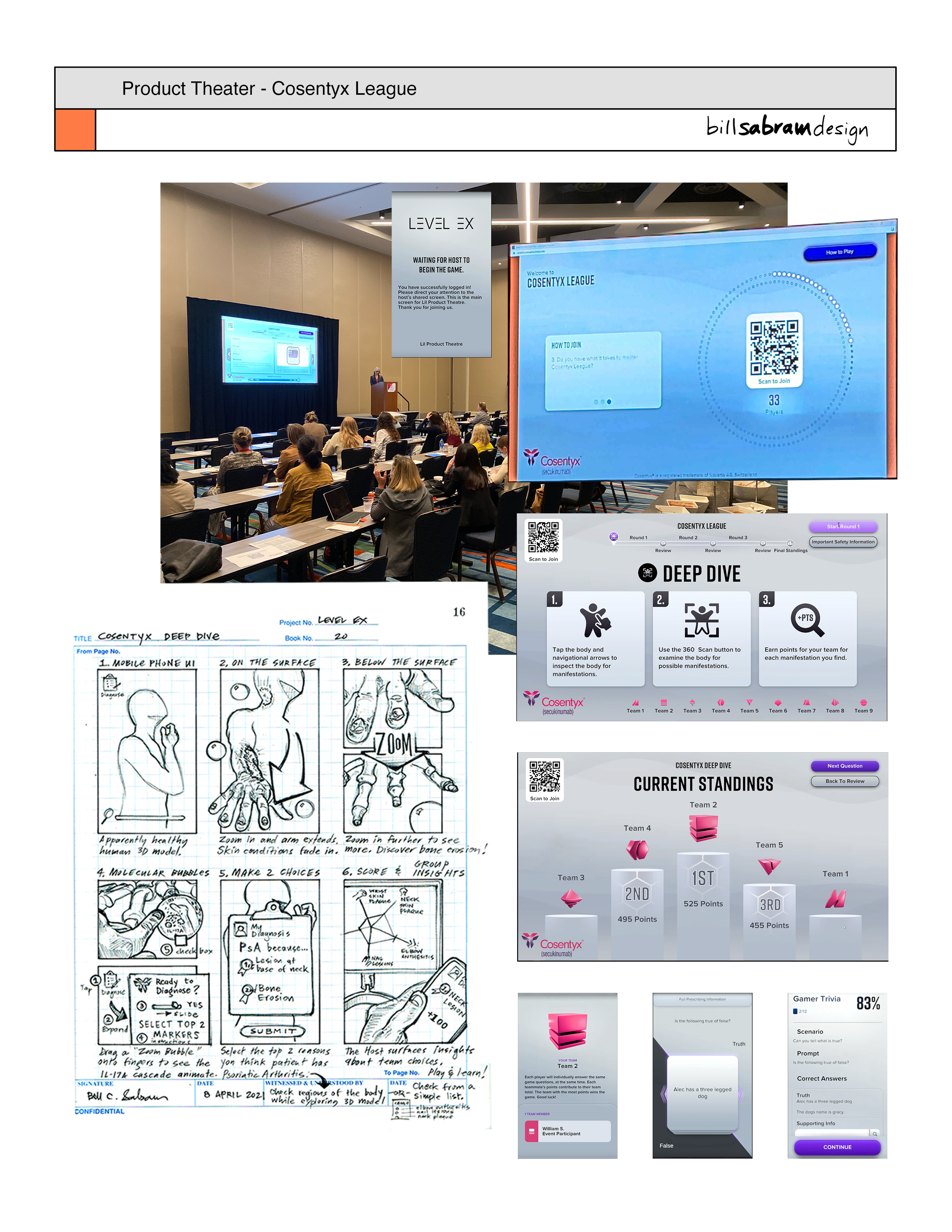
Product Theater was the most profitable platform at Level Ex and I was brought in to transform it from a promising tech demo into a polished, conference-ready live game show.
The streaming infrastructure was already in place, supporting up to 8 players. My job was everything else: the user experience (split across your personal device and a large theater screen), the game structure in rounds with content reviews (on your device and moderator-led on stage), engaging medical game content, scoring, the pacing, and the countless small details that separate a game people tolerate from one they genuinely want to play.
Getting content approved by pharma legal and medical teams is its own design challenge — every word, every scenario, every piece of clinical language has to pass rigorous Medical Legal Review (MLR) before it ever hits a screen. I navigated that process while keeping the experience feeling alive and fun, not like a compliance exercise.
I designed the team structure so players were sorted randomly, celebrated between rounds, and never made to feel bad if their team didn't place. In a room full of competitive medical professionals, that balance matters.
But the detail I'm most proud of is one most players never consciously noticed.
When attendees entered the room, a large mostly blank theater screen greeted them. As each player scanned the QR code, a dot appeared in a large growing circle of dots. This central visualization did many subtle but powerful things. As a player completed registration on their phone, their dot lit up in a bright, happy color in real time. The whole room could see the circles filling in and pulsing with life. The moderator on stage could see at a glance when the room was ready — and know exactly when to say let's play.
No countdown timer. No repetitive, "Is everyone in?" No one left behind.
That's Game Design Thinking - - - sweating the small moments that make the whole experience feel effortless to the people living inside it.